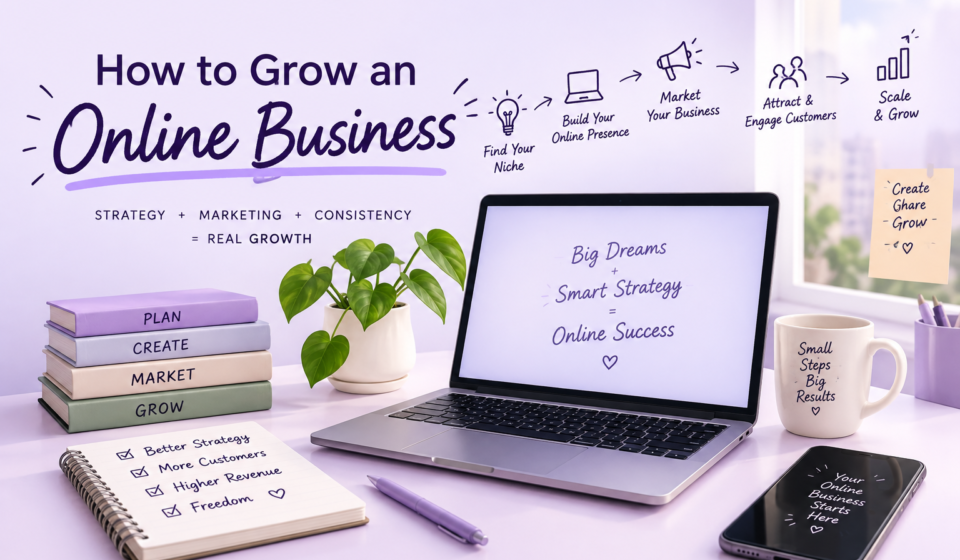

Starting an online business is easier than ever, but growing it successfully requires more than just a website or an Instagram page. With increasing competition, businesses need a clear strategy, strong online visibility, consistent marketing, and a clear understanding of their target audience.
Whether you are a small business owner, freelancer, or service provider, digital marketing can help you reach the right customers and grow your online presence. An AI digital marketing course in Meerut can also help beginners understand how modern digital tools and marketing strategies can work together effectively.
1. Clearly Define Your Business and Target Audience
The first step to growing an online business is clearly defining what you offer and understanding whom you want to serve.
A common mistake is trying to sell to everyone. When your target audience is too broad, your marketing messages become generic. Instead, identify the people who are most likely to need your product or service.
Consider factors such as:
1. Age and location
2. Profession or lifestyle
3. Problems they are trying to solve
4. Buying behaviour
5. Budget
6. Online platforms they use
For example, a premium skincare brand may target young working professionals who are interested in skincare rather than simply “everyone interested in beauty.”
The clearer your target audience, the easier it becomes to create relevant content and advertisements.
2. Build a Professional Online Presence
Your online presence is often the first impression customers have of your business. A professional website helps build credibility and gives potential customers an easy way to learn about your products or services.
Your website should include:
1. Clear information about your business
2. Easy navigation
3. Mobile-friendly design
4. Fast loading speed
5. Clear product or service descriptions
6. Contact information
7. Strong calls to action
Social media can support your website by helping you engage with your audience regularly. Instead of being present on every platform, focus on the ones where your target customers are most active and build a consistent presence there.
3. Use SEO to Increase Organic Visibility
SEO is a key long-term strategy for growing an online business. It helps your website appear in search results when people look for products, services, or information related to your business.
Start with keyword research and naturally incorporate relevant search terms into your content. For example, a digital marketing institute in Meerut could target keywords such as “digital marketing course in Meerut” or “AI digital marketing course in Meerut.”
SEO also involves technical optimization, creating useful content, internal linking, improving website speed, and earning quality backlinks.
Unlike paid advertising, SEO takes time to deliver results. However, once your website starts attracting consistent organic traffic, it can become a valuable source of potential customers.
4. Create Useful Content
Content marketing helps online businesses attract potential customers before they’re ready to make a purchase. Instead of constantly promoting your products, create valuable content that answers questions and solves problems related to your industry.
You can create:
1. Blog articles
2. Instagram Reels
3. YouTube videos
4. Tutorial
5. Guides
6. Infographics
7. Case studies
8. FAQs
For example, a graphic designer could publish content about common design mistakes, while a fitness brand could share beginner workout tips.
The goal is not simply to produce a large amount of content. Useful and relevant content is more valuable than posting every day without a clear purpose.
5. Use Social Media Strategically
Social media can help businesses build awareness, interact with customers, and generate leads. But posting randomly is not a strategy.
Create content around a few clear categories. For example, a business could use:
1. Educational content to build authority
2. Behind-the-scenes content to build trust
3. Customer testimonials to provide social proof
4. Product demonstrations to explain benefits
5. Promotional content to drive sales
Consistency also matters. You do not need to post ten times a day. A realistic schedule that you can maintain is better than an ambitious schedule that you abandon after a few weeks.
6. Learn How AI Can Improve Digital Marketing
AI is transforming digital marketing by helping businesses generate content ideas, analyse data, research keywords, understand customer behaviour, create marketing drafts, and automate repetitive tasks.
However, AI should not replace human judgement.
AI-generated content can sometimes be repetitive, inaccurate, or disconnected from the audience. Businesses still need to review information, add original insights, and maintain their brand voice.
Learning digital marketing fundamentals alongside AI tools can help business owners and marketing professionals develop more effective marketing strategies.
An AI digital marketing course in Meerut can provide structured learning on how AI can be applied to SEO, content marketing, social media, and online advertising.
7. Build Trust Before Focusing Only on Sales
People are less likely to buy from a business they do not trust.
Your online business should make it easy for potential customers to verify that you are genuine. Customer reviews, testimonials, case studies, transparent pricing, professional communication, and clear policies can all help build credibility.
Do not make unrealistic claims simply to generate quick sales. A short-term sale is not useful if it damages your reputation.
Focus on delivering what you promise. Satisfied customers can become repeat buyers and may also recommend your business to others.
8. Use Paid Advertising Carefully
Paid advertising can help an online business reach potential customers faster than organic marketing alone.
Platforms like Google Ads and social media advertising help businesses reach specific audiences based on factors such as interests, demographics, location, and online behaviour.
But spending money on advertisements does not automatically produce sales.
Before running campaigns, make sure you understand:
1. Your target audience
2. Your advertising objective
3. Your budget
4. Your customer acquisition cost
5. Your conversion rate
6. Your return on advertising spend
Start with a controlled budget, test different approaches, and analyse the results before increasing your spending.
9. Track Your Results
One of the biggest advantages of an online business is the amount of data available.
Use analytics tools to understand where your visitors are coming from, which pages they visit, what content performs well, and where potential customers leave your website.
Track meaningful metrics such as:
1. Website traffic
2. Leads generated
3. Conversion rate
4. Customer acquisition cost
5. Sales
6. Repeat purchases
7. Revenue
Do not judge your marketing only by likes and followers. A post with fewer likes can sometimes generate more enquiries or sales than a viral post.
10. Keep Improving Your Strategy
Growing an online business is not a one-time task. Customer preferences, search algorithms, social media platforms, competitors, and digital tools keep changing.
Review your performance regularly and identify what is working and what is not.
If a particular content format consistently generates enquiries, create more content around that format. If an advertising campaign is spending money without generating results, investigate the problem instead of blindly increasing the budget.
The businesses that grow sustainably are usually the ones that keep testing, measuring, learning, and adapting.
Conclusion
Growing an online business requires a combination of clear positioning, a professional online presence, SEO, valuable content, social media, paid advertising, customer trust, analytics, and continuous improvement.
AI is also becoming an important part of modern digital marketing. It can help businesses save time, analyse data, and streamline marketing processes. However, technology alone cannot grow a business. A strong understanding of customers and solid marketing fundamentals still matter.
The goal should not be simply to gain more followers or website traffic. It should be to attract the right audience, build trust, convert visitors into customers, and develop relationships that encourage repeat business.