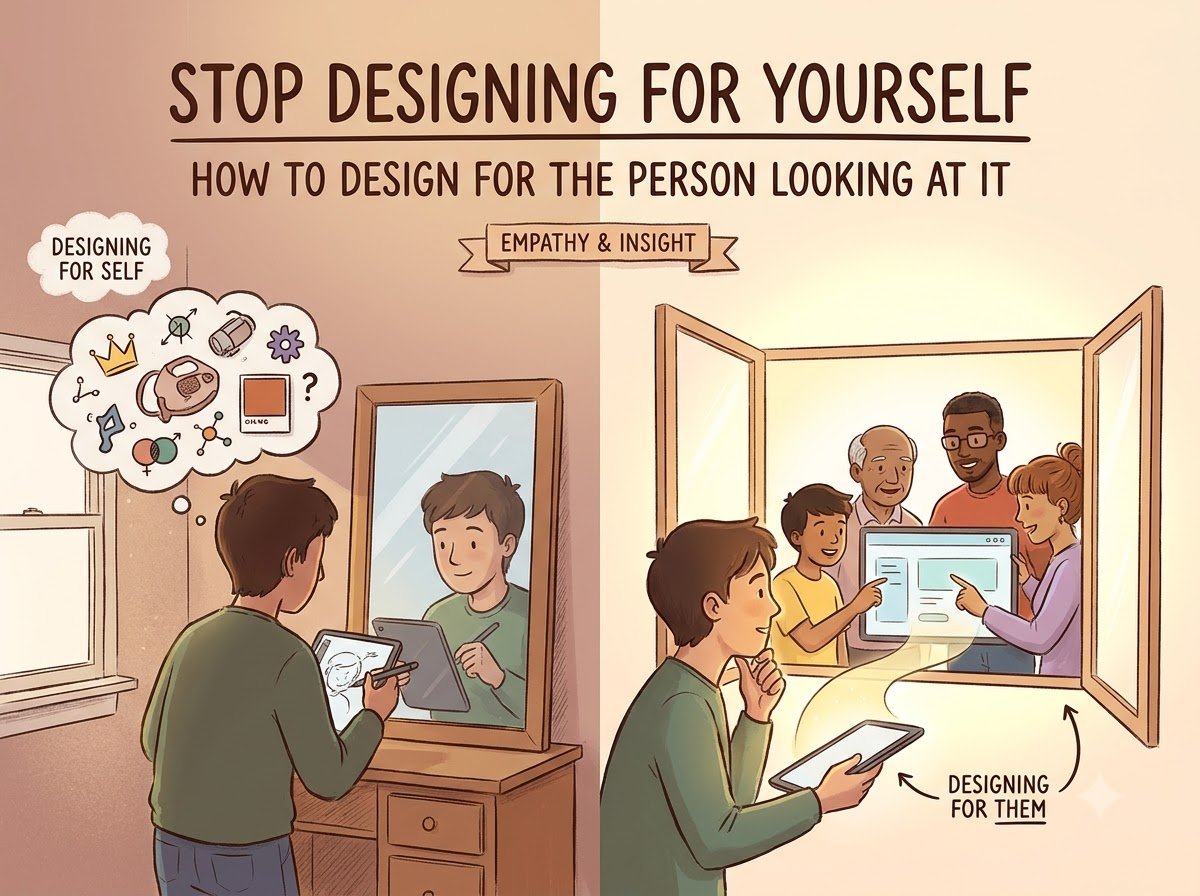

A common mistake in graphic design is simple: designers often design for themselves instead of designing for their audience.
You choose a colour because you love it.
You select a font because it looks stylish.
You add a layout because you think it looks creative.
And then you show the design to someone and ask, “Do you like it?”
But there is a bigger question you should be asking: “Will the right person understand and respond to this design?”
That is the difference between designing something you personally like and designing something that actually works.
Your Favourite Design Is Not Always the Right Design.
As a designer, you naturally have your own preferences.
Maybe you love minimal designs. Maybe you prefer bold typography. Maybe you enjoy pastel colours, dramatic gradients, or unusual layouts.
There is nothing wrong with having a personal style.
The problem starts when your personal preference becomes the main reason behind every design decision.
Imagine you are designing a poster for a children's activity centre. You personally love black, white and grey minimalism. So you create a clean design using thin typography and lots of space.
It may look beautiful to you.
But will a child or a parent immediately understand what the poster is about?
Probably not.
A colourful, energetic and friendly design might communicate the message much better.
This is the key difference:
Personal preference asks, “Do I like this?”
Good design asks, “Does this work for the audience?”
Design Is Communication, Not Decoration.
Graphic design is not just about making things look attractive.
At its core, design is communication.
A good design should help someone understand something, feel something, or do something.
Think about an Instagram advertisement.
If the viewer cannot understand the offer within a few seconds, it does not matter how beautiful the design is.
If the headline is difficult to read, the typography has failed.
If the button does not stand out, the hierarchy has failed.
If the colours do not match the brand or message, the visual language has failed.
A design can be aesthetically pleasing and still be ineffective.
That is why “It looks good” is not enough.
First, Know Who’s Viewing the Design.
Before opening Canva, Photoshop or Illustrator, ask one basic question: “Who am I designing this for?”
Do not settle for a vague answer like “everyone.”
A design made for everyone often ends up connecting strongly with nobody.
Instead, think about the actual audience.
Are they:
1. Teenagers?
2. Working professionals?
3. Parents?
4. Small business owners?
5. Luxury customers?
6. Students?
7. Fitness enthusiasts?
8. Travellers?
Their expectations, interests, and behaviours will vary.
For example, imagine you are creating a social media post for a premium skincare brand.
A luxury audience may respond better to elegant typography, controlled spacing, subtle colours and high-quality photography.
Now imagine using the same approach for a children's toy brand.
It would probably feel too serious and boring.
The design has not suddenly become “bad”.
It is simply wrong for the audience.
Ask What Your Audience Needs.
Knowing your audience is only the first step.
You also need to understand what they need from the design.
Suppose you are designing a food delivery advertisement.
The audience probably wants to know:
1. What is the food?
2. How much does it cost?
3. What is the offer?
4. Where can I order?
They do not want to spend 10 seconds trying to understand your creative concept.
This is where designers sometimes make a mistake.
They become so focused on creating something visually impressive that they forget the actual purpose of the design.
Your design should not make the audience work harder than necessary.
Make the message easy to find.
Design for Their Taste, Not Yours.
This does not mean you should completely ignore your design style.
Your creativity still matters.
But your creativity should work within the needs of the project.
For example, you may personally dislike bold fonts.
But if the brand is young, energetic and playful, a bold typeface might communicate the personality better than your preferred elegant font.
You may love dark backgrounds.
But if the target audience is looking for a fresh, clean and approachable healthcare brand, a lighter visual direction might work better.
Professional designers understand this difference.
They don't ask: “What would I choose?”
They ask: “What would make sense here?”
That shift in thinking can completely change your design process.
Learn to Separate Feedback from Personal Opinion.
Here is another important point.
Not every opinion about your design is equally useful.
Someone might say: “I don't like this colour.”That does not automatically mean the colour is wrong.
You need to ask why.
Does the colour reduce readability?
Does it clash with the brand?
Does it fail to create enough contrast?
Does it send the wrong emotional message?
If the answer is no, it may simply come down to personal preference.
On the other hand, if your target customers consistently struggle to understand the message, that is important feedback.
This is why designers should learn to separate personal opinions from design problems.
Test the Design Before You Defend It.
One of the easiest ways to stop designing for yourself is to test your work.
Show the design to someone who represents your target audience.
Then ask questions such as:
What do you notice first?
What do you think this design is about?
What action do you think you should take?
What feels confusing?
These questions are much more useful than simply asking: “Do you like it?”
Because “Do you like it?” measures personal taste.
The other questions measure whether your design is communicating successfully.
A Simple Rule: Purpose Before Preference.
Before finalising a design, take a step back and ask yourself five questions:
1. Who is this design for?
2. What do I want them to notice first?
3. What should they understand?
4. What action should they take?
5. Does every major design decision support that goal?
If the answer is yes, you are designing strategically.
If the answer is, “I used this because I liked it,” stop and question that decision.
Maybe it is the right choice.
But it should have a reason beyond your personal taste.
The Best Designers Know When to Put Their Ego Aside.
Designing for an audience does not mean removing creativity.
It means using creativity with purpose.
Your personal style can make your work recognisable. Your ideas can make a design memorable. Your creative decisions can make a project stand out.
But the audience is the person who ultimately experiences the design.
You are not the final viewer.
That is something every designer needs to remember.
A design does not succeed because the designer loves it.
It succeeds when the right audience sees it, understands it, connects with it and responds to it.
So the next time you create a design, don't ask only: “Do I like this?”
Ask the more important question: “If I were the person this design is meant for, would this actually work for me?”
That is the point where designing stops being about personal preference and starts becoming real communication.